Sonntag, 5. Januar 2014

More impressions of Madhya Pradesh's Agriculture

Cotton is one of the major crops grown in this region of Madhya Pradesh. In organic cotton production, the harvest is currently still going on, while most of the conventional cotton farmers have already uprooted their cotton plants in order to sow wheat (a short-season "Rabi crop", meaning spring crop, because it is sown in winter and harvested in spring.) 


After the cotton harvest is over, some farmers let the cattle into the fields to feed on the last edible parts that are left. Then the plants are uprooted and used as a firewood supply for the rainy season.


Other major crops which are currently grown are chickpeas, sugarcane and, as I mentioned before, wheat. The soybeans, which are also a major crop in this region, have been harvested in October. 

Here is a wheat field in the front, and a sugarcane field at the back.


Both chickpeas and wheat need irrigation, which here in the vicinity of the Narmada river is done by flooding the fields (see previous blog entry "Rural India"). Wheat needs around 6 irrigations, chickpeas need 2-3 floodings.
Here are some close-ups of the chickpeas. There are different varieties. I've come across two, a white- and a purple-flowering one:


The first lots of chickpeas are already on the market!


And one evening, we were introduced to the easiest way of preparing chickpeas! Make a little fire and lay the whole plants on it. Then pick the chickpea-pods which are roasted, peel them and enjoy! The taste is delicious!

Next to chickpea and soybean, the other pulses which are cultivated are mainly pigeon peas, mung beans, and green peas. This is a field of pigeon pea-shrubs. Pigeon peas are the main ingredient for the daily Dal (lentil-soup).


Of course there are also many vegetable crops such as Tomato, Chilli, Cucumber, Eggplant, Onion, Carrot etc.

The harvested red chillies are dried in the sun, which looks so stunningly beautiful and always catches ones eyes!


 Yet, tomato and chilli are very demanding crops and conventionally grown with the heavy use of pesticides and chemical fertilizers.


And there are lots of very tasty fruits, many of which I've never even heard of (this would fill a whole new blog entry ;))  Though most common are bananas and papaya. But also these two crops need very intensive irrigation..Here's a banana plantation:


And last but not least India is known for its many spices! Coriander or in Hindi dhaniya (Coriandrum sativum), Fennel or somph  (Foeniculum vulgare), Caraway or kaala jeera (Carum carvi) Cumin or jeera (Cuminum cyminum), Turmeric or haldii (Curcuma longa) and many more! But especially this plant is one of my favourites: Fenugreek (Trigonella foenum-graecum), in Hindi "Methi", is wonderful if prepared as a vegetable like spinach. But even more exclusive are the seeds used as a spice in various dishes to give them a special flavour. Methi is an important Ayurvedic medicinal plant.


Freitag, 3. Januar 2014

The Rabari - Nomads from Rajasthan


Rural India

The beauty of barren landscapes, used for grazing or as a meagre wood source


...and the beauty of the colourful clothes within these rather arid areas

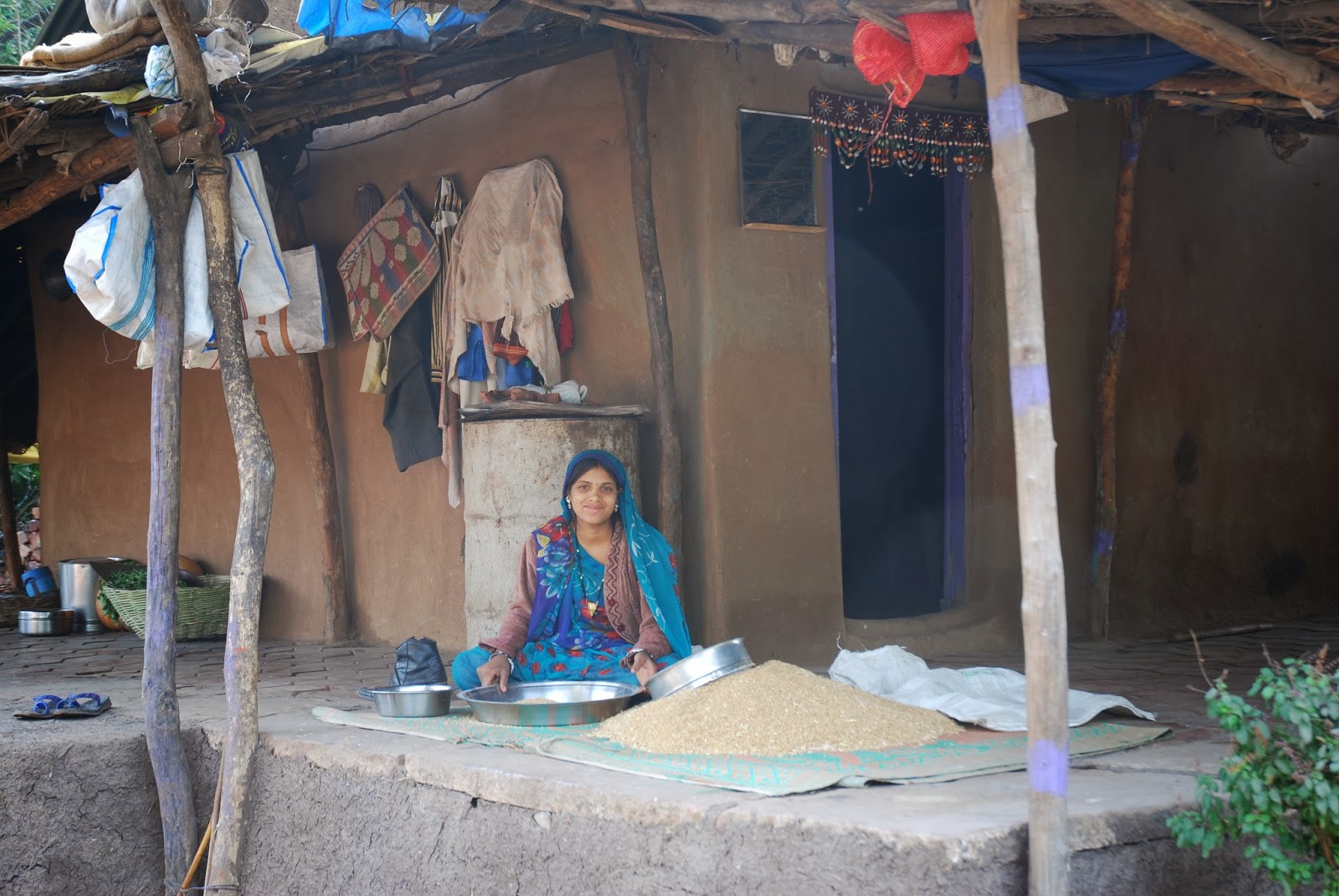
...the beauty of housing constructions from wood, cow dung, mud, bricks...


Ploughing by the power of oxen in the fields of the research centre

Sowing of chickpeas with oxen

The sowing device

In the region of the Narmada river, farmers have the privilege of having enough water to irrigate their fields by flooding them... On the arable land, the river water is used intensively (if not excessively and unsustainably...) and this cultivated, green land appears as a great contrast to the mostly arid conditions.
This is how a flooded field looks at the time of sowing...


...and this is the striking contrast between the barren and arable land

Dienstag, 10. Dezember 2013

Project Work


The field of activity of my host organisation:

In this blog entry, i will first describe some of the current research activities of bioRe and the FiBL here in India. Most importantly, there is the Long Term Experiment, a trial where the different farming systems, namely the Organic, Biodynamic, Conventional and Bt-Conventional, are compared. This experiment has been set up in 2007 and will run for at least 10 years. Cotton, Soya and Wheat are the crops which are rotated. The objectives are to quantify
  • how organic farming affects yield and yield stability (especially in seasons with extreme weather conditions such as drought or flood), product quality and product storability, compared to the conventional system
  • how organic farming affects the stability of the agro-ecological system, with emphasis on soil fertility, beneficial organisms and biodiversity, compared to the conventional system
  • natural and economic resource effectiveness (output/input relationships) of the organic system compared to the conventional system.
Other current research activities are for example the Green Cotton Project and the Participatory Cotton Cultivar Evaluation trial. These trials aim at developing locally adapted cultivars as well as maintaining and increasing genetic diversity, because even though the majority of the world's organic cotton is produced in India, it became extremely difficult to find suitable cultivars for the organic production. Hybrids (adapted to high input farming) and GM-cotton are presently dominating the Indian seed market (> 90%) and as hybrid seed needs to be purchased each season farmers have lost their traditional knowledge on seed production.
Moreover, there is a large risk of contamination with GM cotton and the loss of locally adapted genetic resources. So the FiBL, bioRe (Ltd.) and the University of Agricultural Sciences (UAS) Dharwad initiated a long term Cotton Breeding Project with the main aim to safeguard the heritage of Indian Desi cotton, maintain genetic diversity, avoid GM contamination and support the organic farmers with suitable cotton cultivars. 

My project


Now, this is not all. As I have mentioned in an earlier blog entry, the study I am conducting here is embedded in the Participatory Technology Development, where the needs of the organic farmers are identified and addressed. The current efforts of the PTD go on the one hand into the improvement of manure management options, and on the other hand into the development of suitable pest management strategies for organic farmers. 
And my project only represents a part of the work which is done in this latter. 

On the one hand I am continuing the research (started by Claudia) about spraying intervals with different self-made pest control products focussing on their impact on pest infestation and yield. These trials are still going on, the pest control products are sprayed at a regular basis, observations are done and the weight of the harvested cotton is recorded. 
Every other week I go to the trials in the farmers fields, bring them the self-made product they should spray in their/our on-farm trial and I do different kinds of observations on pest infestation.
Here is one of our organic farmers, Ambaram, on who's field we have a pest trial. On this photo he is spraying a self-made organic product we prepared for him, namely Top 10, in the plots where we prescribe him when and what to spray. These plots are then compared to the plots where he sprays in the way he usually does (or in his case, does not spray at all).


Top 10 is made of cow urine, cow dung and the extract from the fresh green leaves of the following 10 plants: The Neem tree (Azadirachta indiaca), the castor oil plant "Arandi" (Ricinus communis), the sugar-apple tree "Sitafall" (Annona squamosa), the five-leaved chaste tree "Nirgud" (Vitex negundo), the pink morning glory "Tamesar" (Ipomoea carnea), Nerium Oleander "Kaneer" (Nerium indicum), the Devil's Trumpet "Datura" (Datura festiosa), the Indian Beech "Karanj" (Millettia pinnata), the Papaya "Papita" (Carica papaya) and the Sodom Apple "Acao" (Calotropis procera). 

It is a self-made pesticide against sucking pests and caterpillars and is effective due to bitterness, bad odor and other properties coming from the plant’s alkaloids. This is just one of the various self-made products which are used in the pest trials.

On the other hand, I am focussing on options and tools for pest monitoring. This is an important aspect of a good pest management strategy. Because usually the organic farmers only spray when the pest problems become visible, which often means that the economic threshold levels are reached, possible ways to monitor and estimate the pest pressures need to be found.
Since now, I have done a lot of literature review on this, I have compiled and collected ideas and I have tried to find out about the availability of monitoring tools on the local market. Yet this last aspect is difficult to do for a foreigner in India. The information is only orally available and many phonecalls are necessary for what you have to know at least Hindi, if not even the local language (Nimadi, the "d" more sounding like an indian "r")... And even if you find somebody who offers you what you are looking for, then you are never sure if you couldn't get the same thing from somewhere else (maybe closer) for much cheaper.

The aim is then to assess the potential of these options and tools to monitor pest infestation firstly for on-station trials and secondly to assess the applicability for farmers. For this purpose I am setting up demonstration trials, I conduct workshops and most importantly I do surveys with bioRe staff, extension officers and farmers to find about their view on this subject.

Only just last Monday I had my fist workshop with the farmers advisory committee. I gave a small presentation, demonstrated some monitoring tools on the demonstration farm and had my questionnaires filled out by them.

I am happy to share some photos of that day:


The further steps that are planned are of course to install more demonstration trials and reach as many farmers as possible to demonstrate them to and to get their opinion on the possibility to use such monitoring options and tools. 

For the other trials the aim is to continue to collect data and to do a cost-benefit analysis to find out, if and which spraying interval/ treatment could be worth adopting in the future. 

Montag, 9. Dezember 2013

The reality of life from next door

Since quite a while I was thinking about sharing some photos of the surroundings, not of where I live, but some impression from just outside this little paradise where I live in...

There is especially one family that I would like to portray here. Unfortunately I know quite nothing about them, but there's still some time and I hope to at least get to know some of their names. I have given them some old clothes from other people and myself and occasionally brought them something small to eat, like bananas or some sweets for the Diwali Festival. 
They live just in front of the bioRe campus in a shabby home and I think they own this ox, because this one is always tied there near a tree. I was told that the father works as the guard of the fields (sugar cane) and earns 2000 rupees (30 swiss francs) in a month. 


There are four children, all with adorable faces and a vivid eyes. 


 The oldest girl usually takes care of the younger siblings. And she comes often close to our room and wants me to come over so we can crush some of the very tasty Indian Almonds together (Terminalia catappa, in Hindi called Padam). Or she would climb up a small Guava tree (Psidium guajava) and offer me some fruits, though they were usually not quite ripe enough when she picked them....


And here is their mother. She was very proud to be taken on a photo and I showed it to her afterwards, which was when I could tell that this woman must have no proper access to any water body, let alone sanitary facility...

It makes one feel helpless when one gets insights into these realities and I find it astonishing how normal this is for the Indians which are a little bit better off. The poor are given no attention, they're just there, that's how it is. At the same time it is not astonishing, because what else is one supposed to do? And it is of course the dominant image of the country. However, I've been told that where the gap between rich and poor is much wider, there is real disgust, and this I find is a true cause for concern.